




Recap of the pentateuchal investigation.
After the discovery of the Kenobi Archive papers, the investigation into the mysterious phenomenon of disappearing handkerchiefs has entered a new phase. The evidence gathered in the first episode already suggested a disturbing but plausible possibility: handkerchiefs don't get lost. They migrate.
In the second book of our pentateuchal journey, we finally get to the heart of the matter: the first field observations, the migratory theory, and the surprising hypothesis of an intercontinental route to South America.
Episode 2 — The expedition and the encounter
In the latter half of the nineteenth century, Henry Morton Stanley was advancing in the oblique light of the African savanna, preparing for one of the most famous encounters in the history of exploration. The expedition proceeded through dusty tracks, distant villages, crates of provisions, folded maps, and men already tired of the heat, sand, and uncertainties.
Everything suggested a scene destined to enter the history books: the explorer's arrival, mutual recognition, the conventional phrase, the perfect ritual of Victorian geographical epic.
But things, as often happens in great scientific breakthroughs, did not go according to plan.
The interrupted meeting!
Stanley was about to utter the famous introductory formula, when Dr. Livingstone, instead of playing along, looked up at the sunset sky and interrupted all formalities.
“Never mind the introductions, Stanley. Look there.”
Indeed, above the savanna, a flock of small white objects was moving, arranged in formation, propelled by the wind but not entirely subject to it. At first glance, they might have seemed like seafowl off course. Upon closer inspection, no.
They had no feathers. They had no beaks. And above all, they possessed that typical aerodynamic indecision characteristic of good quality domestic textiles.
They were handkerchiefs.
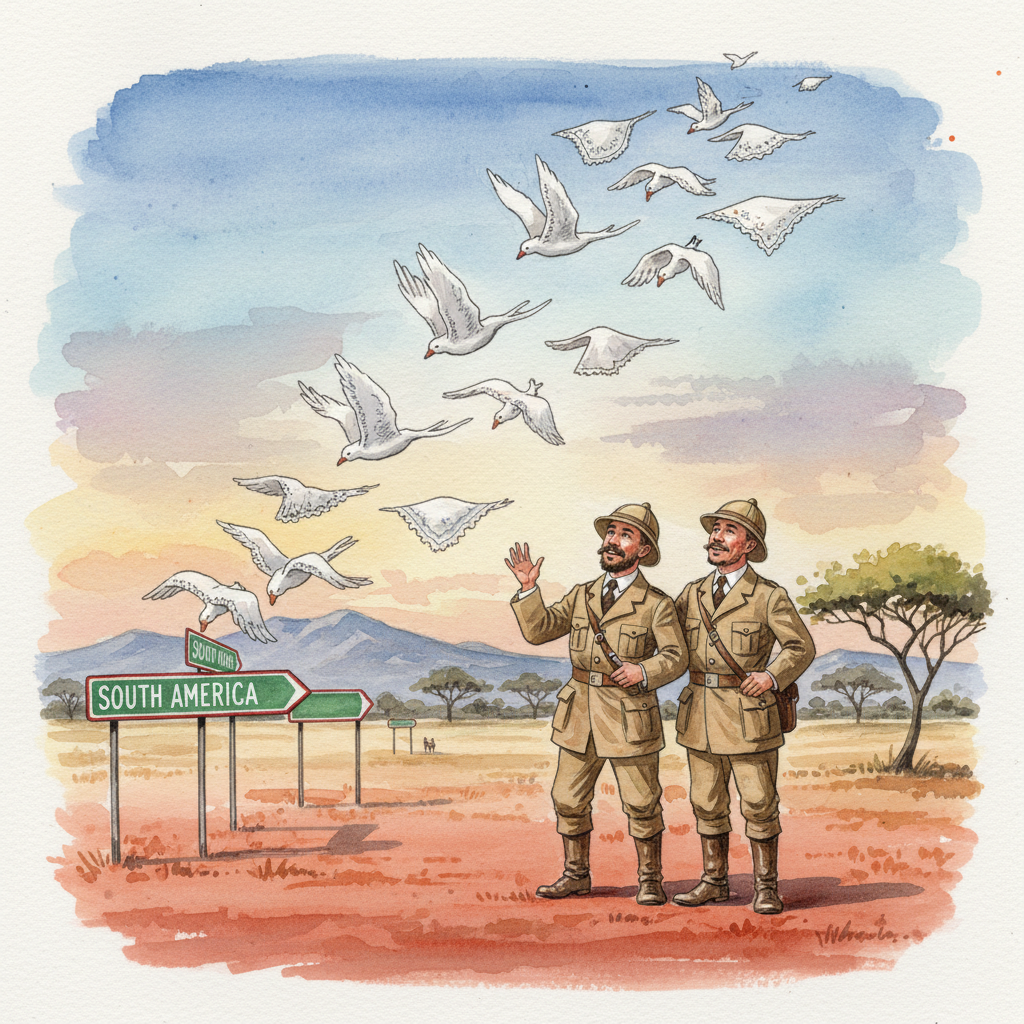
The South America sign!
The wonder grew when the two explorers realized that the flock was not moving randomly. The specimens seemed to be following a precise direction, almost a route, almost a geographical memory inscribed in the very fabric of the threads.
Before them, in a detail as inexplicable as it was decisive, appeared a road sign indicating a single destination:
South America.
What an Italian sign from the following century was doing in the heart of nineteenth-century Africa, no one is yet able to explain. But precisely for this reason the document is precious: it not only records the passage of a migratory flock, but suggests that the handkerchiefs already knew their final destination.
The migratory theory
According to the migratory theory, the European handkerchief does not conclude its existence in a drawer, in the washing machine, or at the bottom of a pocket. These places represent, if anything, temporary stations in a broader textile life, marked by phases of domestic use, fibrous maturation, and finally the impulse to depart.
When it reaches full textile maturity, the Linum Nasalis Migratorius develops a behavior comparable to that of seasonal birds: it senses a call towards the south, evades human observation, and embarks on its journey.
It is the only coherent explanation for three universally observed phenomena:
- its disappearance from pockets;
- its disappearance from the washing machine;
- its disappearance from drawers.
The migration map
Among the most important documents in the kenobian collection is a world map titled World Map of Migratory Routes of Linum Nasalis Migratorius. The document, dated 1874, distinguishes at least three major directions of movement.
- South-west primary route: followed by European specimens of Linum Typicus, which leave the Mediterranean area and head towards the South Atlantic.
- Transoceanic route: attributed to Linum Oceanicus, capable of crossing large stretches of sea in flight formations.
- Asian route: concerning Linum Orientalis, with local variations and probable phenomena of genetic isolation of the fibers.
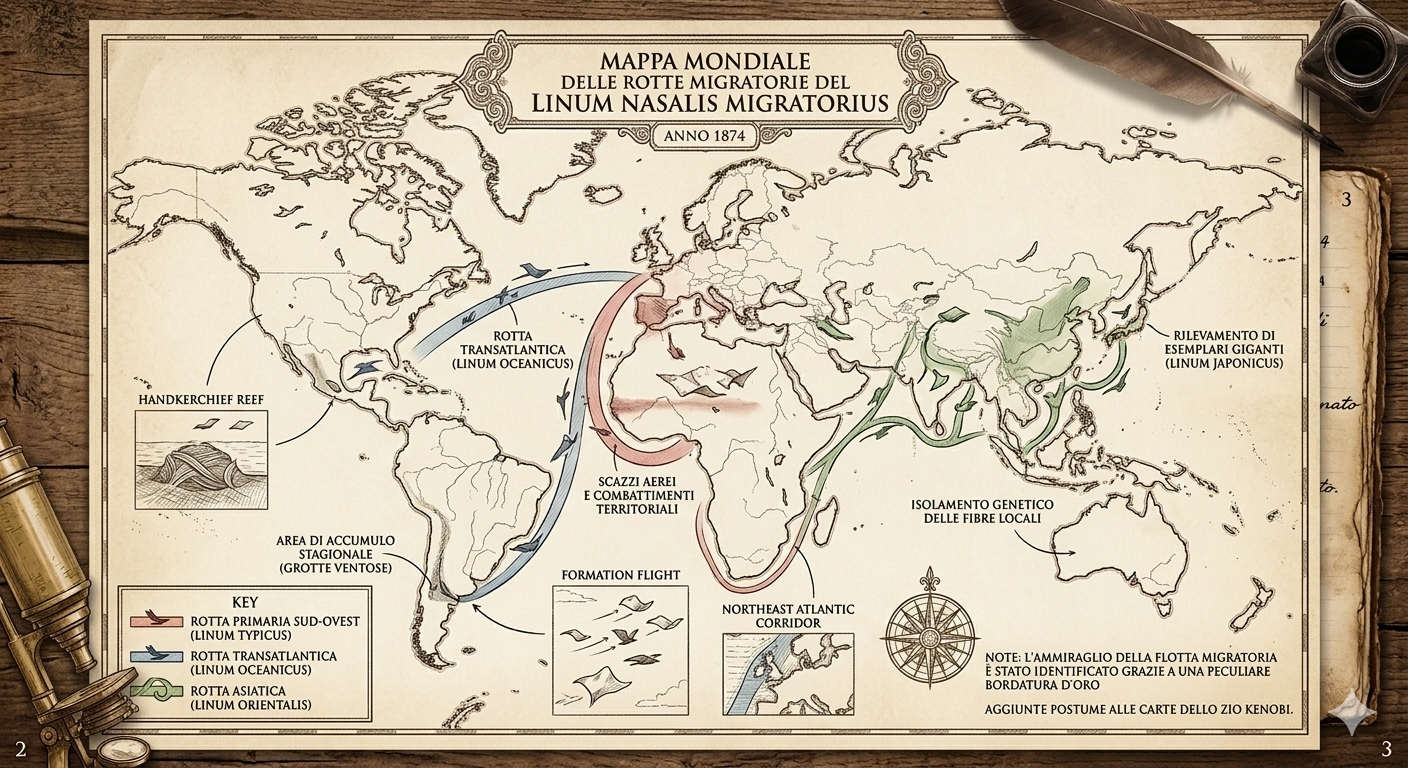
The map also shows details that deserve attention: areas of seasonal accumulation, north-eastern Atlantic corridors, and even episodes of "aerial brawls and territorial fights," a clear sign that the 19th-century scientific community had already intuited the existence of complex dynamics between competing flocks.
Taken together, these elements reinforce the hypothesis that the migration of handkerchiefs is not a random phenomenon, but an organized collective behavior.
The Destination: The Andes
The most recent research, read in light of the migratory map, suggests that a significant portion of the specimens heading southwest do not simply disappear across the Atlantic, but actually reach South America.
According to some sources, the final destination would be a stable colony in the Peruvian Andes, where handkerchiefs that have reached the end of their domestic service would find favorable conditions for survival: thin air, regular wind, reduced human pressure, and an abundance of natural terraces suitable for landing.
The sign observed by Stanley and Livingstone, however anachronistic and entirely inexplicable, would therefore seem to confirm a surprising truth: the flocks already knew where to go.
An investigation just begun
The evidence remains fragmentary, the documents incomplete, and the testimonies yet to be verified. But an interpretive line is now beginning to emerge clearly: the disappearance of handkerchiefs could be the visible reflection of an ancient migratory behavior.
In the next episode, we will therefore move to the highlands of South America, where some sources speak of stable settlements, fabric huts, arriving flocks, and true Andean textile colonies.
The investigation continues.
🎶 “Lyrics”
Stanley, Livingston e lo Stormo Migratorio
archi leggeri + clarinetto
ambiente esplorazioneStanley solo (baritono)
Nella savana dorata dell’Africa lontana
preparo la spedizione e controllo la bussola.
Tra mappe, casse e tende da campo
cerco un uomo di nome Livingston.
Dicono sia qui da qualche parte,
tra fiumi, villaggi e antiche piste…
e quando lo incontrerò dirò finalmente:(si prepara alla frase famosa)
“Dottor Livingston, io presu—”
Arriva Livingston
(tenore)
Stanley! Stanley!
Lasci stare le formalità!
Guardi laggiù sopra la savana!Dialogo cantato
Stanley:
Uno stormo forse di uccelli?Livingston:
No… Stanley… guardi meglio…Stanley:
Non hanno ali!
Livingston:
Non hanno piume!
Rivelazione
Duetto:
Sono fazzoletti!
Fazzoletti in migrazione!Il cartello
Stanley:
E dove stanno andando?
Livingston:
Verso quel cartello laggiù!
Stanley:
Ma quello indica… Sud America!
Livingston:
Ma siamo in Africa!
Finale
Duetto:
Eppure migrano, migrano lontano
seguendo rotte che nessuno sa…
Se i fazzoletti volano così
la scienza dovrà ricominciare da qui!