




Pentateuchal Preamble
The following investigation stems from an ancient and universally shared suspicion: handkerchiefs disappear.
This is not an occasional or domestic disappearance. The phenomenon appears systematic, persistent, and surprisingly resistant to any logical explanation. Entire generations have attributed the disappearance of handkerchiefs to distraction, the washing machine, the wind, or mysterious domestic entities known as “messy drawers.”
However, some recently emerged documents from the Archivio Kenobi suggest a more disturbing possibility: that the common handkerchief (Linum Nasalis) actually possesses its own migratory dynamic.
The rediscovered papers — observation tables, field notes, maps, and taxonomic annotations — seem to belong to an ancient attempt to scientifically classify the phenomenon.
Out of respect for the tradition of great investigative works, and perhaps also due to a certain inclination towards excessive solemnity, the present inquiry has been organized according to a Pentateuchal structure, meaning it is divided into five books:
- I – The Discovery of Forgotten Evidence
- II – Of Routes and Migrations
- III – Of Colonies and Textile Peoples
- IV – The Dispute of Linum Nasalis
- V – Of Quantum Revelation
The reader is invited to approach this research with the spirit that every true scientific investigation deserves: curiosity, caution, and a moderate willingness to accept the improbable.
Because if even one of the hypotheses examined here proves to be founded, then we must finally admit a truth that domestic science has too long ignored:
handkerchiefs do not get lost.
They migrate.
First Episode: The discovery of forgotten evidence

Among the many inexplicable events that plague modern civilization — untraceable remote controls, evaporated chargers, pen caps vanished into thin air — one in particular has remained for too long without serious scientific investigation: the disappearance of handkerchiefs.
For decades, the phenomenon has been dismissed with lazy explanations unworthy of the best investigative tradition: “they must have ended up in the washing machine,” “you left them in your pocket,” “the wind carried them away.” Weak hypotheses, often contradictory, almost always supported by emotionally involved witnesses.
Today, finally, something is changing.
During a reconnaissance within the Archivio Kenobi, some documents have resurfaced that seem to shed new light on this old question.
These are scattered papers, hand-annotated tables, observation notes, and at least one diary page attributed to an anonymous scholar from the Kenobi area active in the second half of the nineteenth century. The collection appears heterogeneous, but shows surprising internal consistency: all materials revolve around a mysterious entity called Linum Nasalis Migratorius.
According to these sources, the common handkerchief is not just a domestic artifact, but a textile organism with its own logic of dispersion, seasonal habits, and perhaps even rudimentary forms of migratory orientation.
Among the most interesting documents is a study table in which the specimen is analyzed from three fundamental aspects:
- the filamentous structure of the fiber, observed with almost microscopic method;
- the aerodynamic configuration of the handkerchief properly folded for flight;
- a brief field report, written in diary form, describing the sighting of specimens in motion.
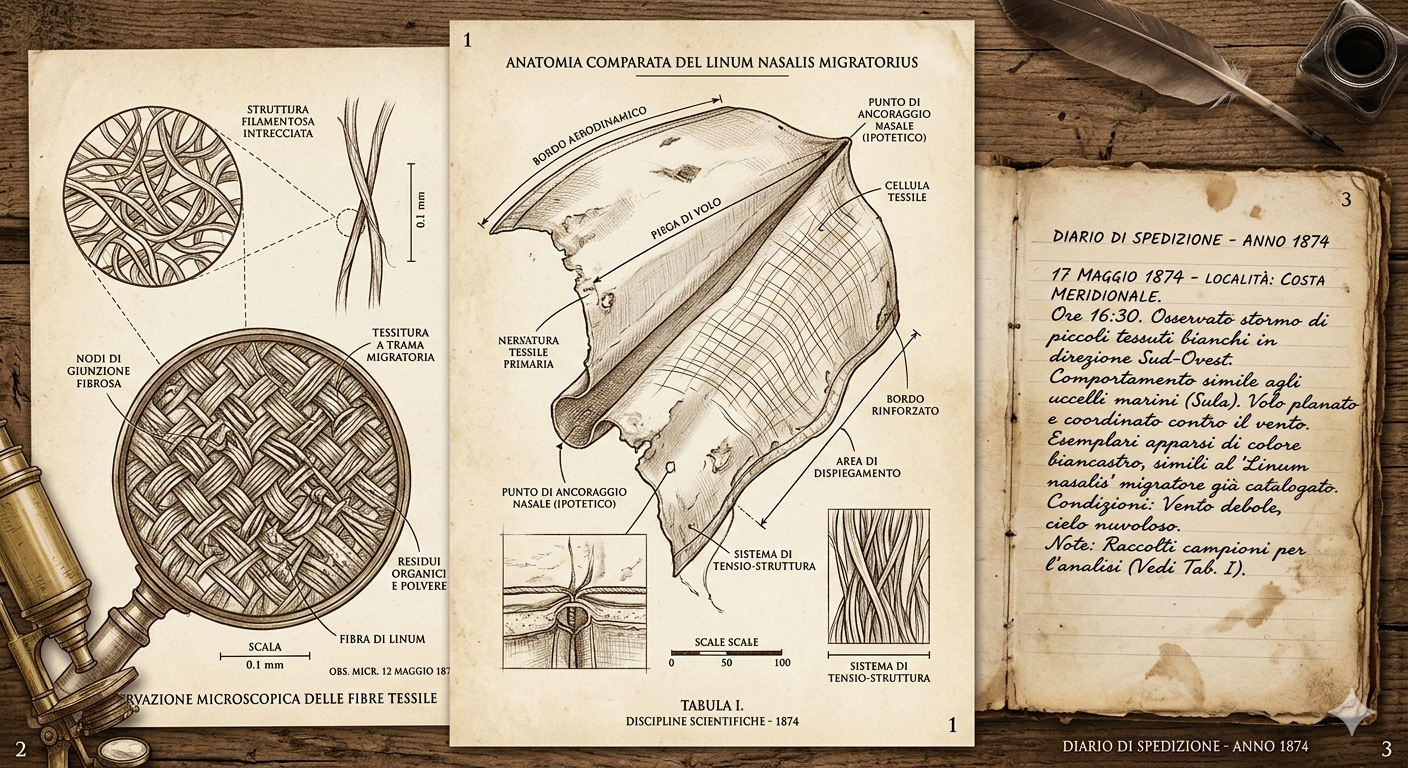
The seriousness of the language used by the authors is particularly striking. They never speak of “pieces,” “rags,” or “little handkerchiefs,” but always of specimens, migration, observation, evidence collection. It is the typical lexicon of someone who does not consider themselves to be dealing with a trivial everyday object, but with a poorly understood natural phenomenon.
One of the best-preserved sheets even contains a note that deserves to be quoted:
“Observed a flock of small white textiles moving in a coordinated manner against the wind. Behavior akin to that of seabirds, but of a clearly textile nature.”
It is difficult to say, at the current stage of research, whether we are faced with an authentic discovery, a colossal nineteenth-century hoax, or both at once — a possibility that, moreover, should never be ruled out when archives, diaries, and men convinced they can classify the world with a fountain pen appear.
But one conclusion, cautious and provisional, can already be drawn:
someone, a long time ago, had taken the problem of missing handkerchiefs seriously.
In the next episode, we will examine the most surprising document of the entire collection: a world map of migratory routes, on which Linum Nasalis Migratorius is traced from Europe to the Atlantic, up to overseas textile colonies.
The investigation, at this point, is officially open.
🔬 Note on the Origin of Kenobian Studies
Among the materials in the Archive, some clues recur with such frequency that it is difficult to consider them random.
Several documents—though lacking explicit signatures—share common stylistic traits: a particular attention to domestic detail, a surprisingly rigorous lexicon, and a certain insistence on apparently marginal phenomena.
Some scholars have hypothesized that these materials may be attributable to a now almost forgotten figure:
NoseOne Kenobi, active in the second half of the nineteenth century.
Sources describe him as a meticulous observer, characterized by a marked sensitivity to atmospheric conditions and, in particular, to nasal ones.
This apparently secondary circumstance led him to develop a constant relationship with the handkerchief, transforming an everyday object into an object of investigation.
To him is attributed, in embryonic form, the first formulation of the so-called textile migratory theory.
According to some indirect testimonies, NoseOne allegedly maintained an epistolary exchange with English scientific circles of the time, where — with much less success — the evolution of species was being discussed.
Whether such contact actually took place, and under what terms, remains a subject of debate.
What appears certain is that, while others observed the natural world,
NoseOne observed the bedside table.
🎶 “Lyrics”
La Disputa del Linum Nasalis
[Baritono – CHARLES DARWIN, severo e distaccato]
Kenobi, mio caro collega,
la scienza non funziona così.
I fazzoletti non migrano,
non sono anatre né colibrì.
Forse l’hai perso per strada,
o dimenticato in qualche caffè,
ma una specie migratoria
richiede prove, lo sai anche te.[Tenore – Professor NoseOne KENOBI, con eccitazione crescente]
Charles! Guarda il tavolo vuoto,
il mio fazzoletto non c’è più.
Ieri stava accanto al libro,
oggi è sparito laggiù!
Io dico che partono in viaggio
come rondini verso il sud,
seguono rotte segrete
che nessuno conosce quaggiù![Duetto – Darwin e Kenobi, voci sovrapposte in stile operetta]
Forse un giorno sapremo
se è follia oppure verità,
se i fazzoletti da tasca
seguono rotte nell’immensità.
Tra appunti, mappe e risate
la disputa continua così:
due vecchi amici che cercano
un mistero impossibile, lì.[Tenore – Professor KENOBI, quasi frenetico, ritmo incalzante]
Ho cercato negli armadi,
nei cappotti e nei cassetti,
ogni inverno ne sparisce uno
come stormi di fazzoletti!
Seguirò ogni indizio,
ogni tasca della città,
finché troverò la prova
di questa misteriosa realtà![Baritono – CHARLES DARWIN, con un pizzico di ironia paterna]
Kenobi, ostinato amico,
la tua fede è quasi poesia,
ma la scienza senza prove
resta solo fantasia.
Eppure ammiro il tuo spirito,
questa ricerca infinita:
pochi uomini inseguono
una teoria per tutta la vita.[Tenore – Professor KENOBI, finale solenne e malinconico]
(Il pianoforte rallenta, diventa un adagio)
Sono vecchio ormai, Charles,
ma ho continuato a cercare...
E oggi ho trovato le prove,
le rotte, la logica, la via:
i fazzoletti migrano davvero,
non era follia.[Baritono – CHARLES DARWIN, voce soffusa, quasi un sussurro]
Ma tu non puoi più ascoltare
questa scoperta che era per noi.
Così chiudo le prove nel cassetto...
e il segreto rimane con noi.
Episode 2 — Migration to South America
(Parlasco, field notes)
For generations, humanity has lived with a mystery that official science has always avoided addressing.
Handkerchiefs disappear.
They don't fall on the street.
They don't accumulate in coat pockets.
And above all, they are never found where we put them.
For years, distraction, disorder, or faulty washing machines were blamed.
But new observations suggest a much more plausible hypothesis:
migration.
The Migratory Theory
According to the migratory theory, European handkerchiefs—after years of service—develop a behavior similar to that of birds.
When they reach textile maturity, they feel an irresistible call towards the south.
It is the only coherent explanation for three universally observed phenomena:
-
they disappear from pockets
-
they disappear from washing machines
-
they disappear from drawers
They are not lost.
They depart.
Early Historical Observations
Some nineteenth-century travelogues may contain the first descriptions of the phenomenon.
During an African expedition, Henry Morton Stanley and David Livingstone noted in their diaries the appearance of strange white objects in the sunset sky.
At the time, they were mistaken for seabirds.
Today, we know that the explanation might be different.
The Destination: The Andes
The most recent research indicates that the migratory route leads towards South America.
Some clues suggest the presence of a stable colony in the Peruvian mountains, where handkerchiefs that have reached the end of their service would live out the last years of their textile existence.
The evidence is still fragmented.
But the testimonies collected seem to converge.
An Investigation Just Beginning
This is only the first stage of our investigation.
In upcoming episodes, we will analyze other scientific and historical hypotheses, including:
-
the textile transmutation observed in the laboratories of Vitropolis
-
the mysterious washing machine–sofa–pocket domestic triangle
-
and other surprising discoveries that could forever change our understanding of the phenomenon.
Final Note
If the migratory theory were confirmed, we would have to accept a surprising truth:
every time a handkerchief disappears from our pocket…
it may simply have begun
its journey to South America.